March, 20 2026
OFFICER REPORTS
Report from Kathleen Paul, President of Dental Anthropology Association
Welcome everyone! This was my first year serving as DAA President, and it has been a wonderful experience getting to work with this dedicated leadership team and connect with many association members in this role. Thanks to everyone here for all you do to support the DAA.
2026 marks the 40th anniversary of the DAA! This has been a busy year. To mark this milestone we have:
held an invited symposium (chaired by Drs. Christina Nicholas and Erin Blankenship-Sefczek
planned a 40th anniversary special issue of Dental Anthropology (edited by Dr. Becca George) based on today’s symposium
launched a new research funding opportunity for students
created a DAA fundraising merch sale site on Bonfire (developed by Dr. Kristin Krueger with designs donated by Dr. Tisa Loewen)!
We look forward to more great things to come this year.
I wanted to take a moment to announce that we have a newly appointed Nominations and Elections Chair, Dr. Tisa Lowen, who we will hear from momentarily. Thanks so much Tisa for taking on this role.
I also just wanted to take this opportunity to recognize someone who is rolling-off the Executive Board after 11 (!) years of service to the DAA. Dr. Marin Pilloud served as the Executive Board Member from 2015-2018, then as President-Elect from 2019-2022. This overlapped with her role as Editor of Dental Anthropology from 2016-2022, after which she served as DAA President from 2022-2025. This is Marin’s last year serving as Past President, and I am so grateful to have had her here to show me the ropes. She has left a lasting mark on both the association and the journal.
I know she was very disappointed to have never received the official meeting gavel during her time as President, so I wanted to present Marin with this token of our appreciation for all she has given to the DAA. Thank you, Marin.
And thanks again, to everyone on the leadership team for your hard work over the last year.
Report from Brenna Hasset, Secretary of Dental Anthropology Association
The DAA has, as of 18th March 2026, 94 active members. If the previous years’ membership was 102, and the year before that 156, then there is a steady decrease evident.

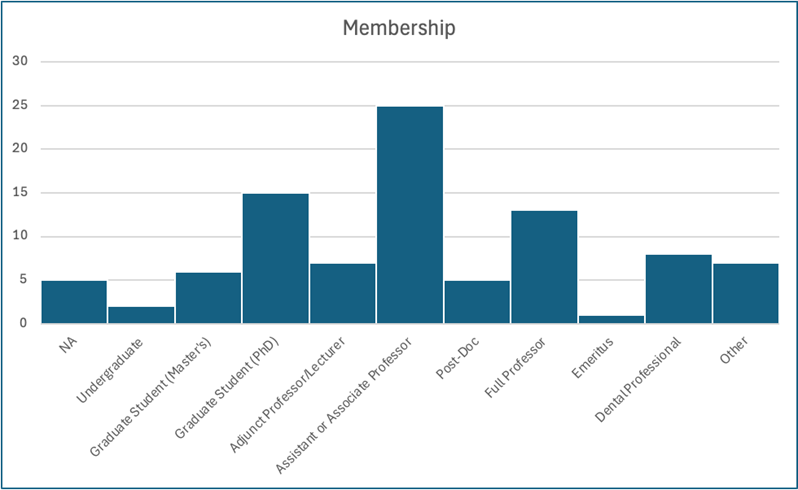
Membership seems concentrated in middle-career practitioners. New membership in 2026 was really driven by graduate students.
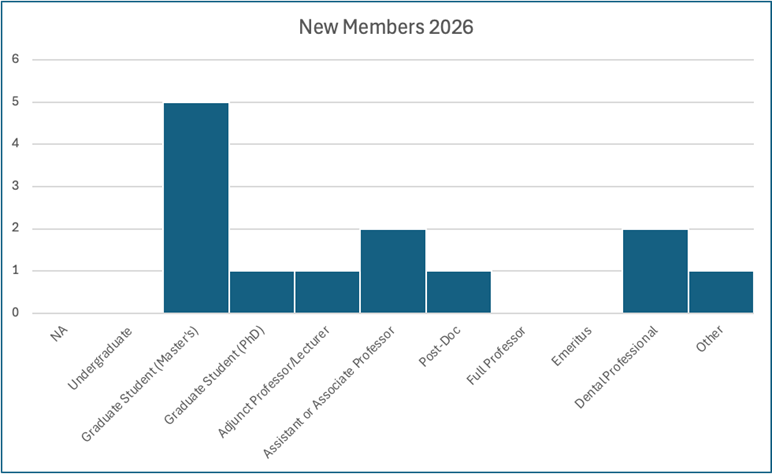
This seems to indicate that we should be trying to encourage more post-doctoral level and above dental anthropologists to engage. I welcome suggestions on how to do this! Perhaps emphasizing the benefit to supervisees of students of being connected in these organizations would be helpful – greater awareness of the Innovation Award or some sort of membership buy-in for nominated awards for students?
Going forward, I will try to establish a more regular email schedule of reminders and DAA outputs (events, journals, awards, etc.) to engage a wider group. Any ideas for cross-posting or other mailing lists that we could promote ourselves to are welcome.
Report from Christina Nicholas, Treasurer of Dental Anthropology Association
As of 3/19/26, the DAA reserves sit at $27,989.72, a decrease from 2025 ($919.84). From March 14, 2025 to March 19, 2026, DAA spent a total of $5550.68, while bringing in $4674.23, for a net of -$876.45.
Costs incurred include AABA-related costs, DAJ journal charges, CrossRef charges, fees to host our website, fees associated with our online payment system, and the 2025 Dahlberg prize. Costs do not include the new student research award, as these have not been paid out yet. Income included membership fees, donations, and Bone Clones royalties ($1630.04). In 2024, the new DAA Innovation Award was established, adding a minor cost for plaques for the winner(s). Expenses in 25-26 increased approximately 62.4% over expenses in 24-25 ($2133.13), while revenues increased 4.8% ($214.84). Journal fees and conference expenses were both notably higher, likely reflecting inflationary changes. Revenue is roughly flat compared to last year, but down from the year before.
Given inflationary forces and a desire to build funding opportunities such as the student research award, it is time to consider raising our dues. The Paleoanthropology Society, a similar small organization, has dues that are now $40. The Human Biology Association’s dues are $160 (full membership; $60 student membership). Both charge additional fees for attending their conferences.
Our current dues are $25 (full membership) and $15 (student membership). The DAA leadership recommends that we increase dues to at least $40 (matching the Paleoanthropology Society). This increase in dues should allow us to support continued growth such as the new student grants. We propose incrementing full membership dues by $5 per year for at least the next 3 years (new dues, $40), starting April 2026. For student members, we suggest one $5 increase in April, 2027. (See New Business below.)
Report from Kristin Krueger, Executive Board Member of Dental Anthropology Association
In my second year as an Executive Board Member, I felt more fully integrated into the organization and its activities. I supported Donovan Adams in organizing this year’s annual workshop by creating and managing the Eventbrite registration site.
I also proposed and implemented a Bonfire fundraising campaign to celebrate the DAA’s 40th anniversary. This involved establishing the platform under our nonprofit status and using several designs for merchandise. To date, the campaign has generated 24 sales and raised $291.59.
Clearly, teeth are better than bones.
Report from Reecie Dern, Communications Officer of Dental Anthropology Association
I took over the role of Communications Officer this past spring following Diana Malarchik’s retirement from the role after four years of dedicated service. Thank you, Diana!
Our organization page on Facebook currently has 2300 followers and our private Facebook group for DAA members and people interested in dental anthropology is sitting right at 4900 followers. We also have a BlueSky account, but it only has 42 followers so if you have an account, please give us a follow! You can also tag us in any DAA-related posts.
This year I focused on learning about our website and social media accounts and promoting our new student grant, annual awards, and AABA activities. Facebook is where we get our most engagement, but I do update BlueSky with the same information. Last year Diana added questions that people need to answer before joining our Facebook group which does seem to be helping with bots, but please answer the questions at least briefly so I can confirm you are not a bot. Also, if you see any spam posts please report them so they can be dealt with quickly.
Finally, I added a link for our 40th anniversary merch store on Bonfire under the Participate tab of the website. There are so many fun items on there, including some with art designed by our very own Tisa Loewen, and all proceeds go to the organization. Also, when you’re on the website, if you encounter any broken links or errors, let me know!
Report from Cassandra Boyer, Student Member of Dental Anthropology Association
I participated in the DAA’s AABA symposium this evening as a discussant. Our annual DAA networking event was also held this evening at Henry’s Tavern. We had 40+ people attend. I am currently live posting on the conference app to encourage attendance of dental sessions. This is my last year of service and I very much enjoyed getting to know you all more. The board has been very inclusive and welcoming to me as the student member. I have felt comfortable and heard when providing opinions/feedback and I look forward to participating more or collaborating on projects in the future. Xoxo
COMMITTEE REPORTS:
Report from Rebecca George, Editor of Dental Anthropology
I’d like to thank the editorial board for their second year of service - they have assisted in preliminary reviews of articles, as well as soliciting reviewers for our submission. I’d also like to thank our reviewers over the past year for ensuring the quality of the articles published - your service has been much appreciated. Thanks to Marin ensuring we are indexed, our impact factor is 0.192. We have been publishing one article per issue for the last year, but there has been an increase in quality submissions. We are on track for at least one, if not two, articles in the July issue. I will be back into regular submission tracking within the week; thank you to our authors for your patience with the process. Also, as of this morning, we have received our first book to review in many years. Finally, in preparation for the special 40th anniversary issue, I am looking to have a large team of reviewers available for the end of this year and into the beginning of 2027 - please get in touch with me if you’d like to be part of that set of reviewers. As always, if you have manuscripts you wish to publish, especially student articles, books to be reviewed, wanting to be a reviewer for manuscripts/books, we would love to consider them. Please just email me at becca.george19@gmail.com.
Report from Erin Blankenship-Sefczek, Chair of Student Prize Committee
2025-2026 Student Prize Committee report:
The Christy G. Turner II/Cambridge University Press prize was evaluated virtually this year. It was opened to students who submitted a dental anthropology-related poster accepted via peer review at any professional meeting from March 2024-March 2025. Applicants submitted a .pdf of their poster and a three-minute video walk-through presentation. As with years past, this format allowed for more submissions and coordinating schedules to watch all submitted presentations.
Winners receive $100 book credit provided by Cambridge University Press. Once again we give a very big thank you to our friends at Cambridge University Press for their continued support of our students through this prize. This year we have funds to recognize up to three posters.
For the 2025-2026 year, we did not have submissions to the Turner/CU Press Poster Award.
The Albert A. Dahlberg Prize is awarded annually to the best student paper submitted to the Dental Anthropology Association. Dr. Dahlberg was among the first modern researchers to describe variations in dental morphology and the endowed fund continues to support student research. We encourage our members to donate to the Albert A. Dahlberg Fund to continue this prize. The winner of the Dahlberg Prize will receive a cash award, a one-year membership in the Dental Anthropology Association, and an invitation to publish the paper in Dental Anthropology, the journal of the Association. This year we have funds to recognize up to two papers.
For the 2025-2026 year we have two winners:
Ruby Diaz from New York University for their work titled "Environmental stress and its effect on molar morphology”
Kaita Gurian from Ohio State University for the work titled “What accentuated striae in tooth enamel reveals about developmental stress in two groups of children in Ohio”
This year, for the first time, we offered the $500 DAA Student Research Support Grant for undergraduate and graduate scholars conducting research on any area in dental anthropology, including oral anatomy/development, paleoanthropology, diet, health, bioarchaeology, forensics, dental evolution, morphology/metrics, biogeochemistry, or any field that draws upon dental data. Funding can be applied to projects in-development or to ongoing studies as a stopgap to support expenses not covered by other funding sources.
For the 2025-2026 year, we had three grant awardees:
Christina Koureta who is a doctoral student at Durham University was awarded this grant to expand on their PhD research project on heavy metal exposure in Northern English antiquity.
Hannah Johnson who is a doctoral student at Louisiana State University was awarded this grant to expand on their PhD project on mastication and enamel wear in South African hominins.
Ashlynn Arzola who is an undergraduate student at the University of Pennsylvania was awarded this grant to pilot her research on the covariance in pelage properties and anterior tooth morphology.
Congratulations, everyone!
Report from Donovan Adams Chair of Workshop Committee
This year’s workshop, hosted by Caitlin McPherson from St. Mary’s College of Maryland, was “Collecting Dental Data from CT scans with Horos. This workshop taught participants how to install and use Horos for data collection regarding dental metrics and crown volumes from CT scans. Also, the workshop gave an introduction to the New Mexico Decedent Image Database.
Nearly 20 people registered for the conference with 16 in-person attendees. This in person attendance is on par with the previous year (despite electrical issues at the Denver airport that caused several people to run late or miss the event!).
If anyone has ideas or interests that they would like to see as a workshop in the future, please reach out to Donovan Adams. I aim to have workshops hosted by people from a diversity of backgrounds, institutions, regions, and career levels.
Report from Tisa Loewen, Chair of Election Committee
Nominations for student members were due March 18. Keep an eye out for the nominee bios and the voting link.
Innovation Award - Kathleen Paul
The deadline for the Innovation Award was extended to March 16 this year. A committee reviewed the submitted nominations, and I am pleased to announce the winner as: Dr. Andrea Papini for his book "On The Origin of Human Masticatory Function: a Darwinian Perspective on Human Chewing Actions" published in Springer Nature. (As a note, our Book Review Editor at the journal, Kent Johnson is currently recruiting reviewers for this book if you are interested in obtaining a free copy.)
To paraphrase from the nomination: This book bridges the gap between human evolution and clinical dentistry, applying an understanding of the evolution of the human dentition to an examination of its contemporary dysfunctions.
The work stands out for its originality of perspective, translational approach, impact on the discipline and practice, didactics, and promotion of the awareness of the developmental and behavioral foundations of common oral health issues.
Andrea Papini is a clinical dentist based in Prato, Italy, with active research in paleoanthropology and bioarchaeology. In addition to this book, he is also the author of publications that span The American Journal of Biological Anthropology, Journal of Anthropological Sciences, Evolutionary Anthropology, PLoS ONE, and Current Biology (to name a few).
Congrats to Andrea!
New Business:
A proposal was made and moved forward to open up a new logo design competition, with the qualification that AI is not used. The old logo will maintain a special place in the DAA.
A proposal was made and moved forward to put to the membership a vote on increasing membership fees to better reflect the running costs of the DAA, inflation, and continuing desire to make the DAA accessible to early career researchers. The amounts proposed are: $50 for regular members, and $15 for student members effective immediately.
Merchandise available on the Bonfire website continues to do well and will be promoted to support the DAA.
Leslea Hlusko of the Tied2Teeth ERC project proposed a shared involvement in the forthcoming DeMoDa database of dental morphology. She made a formal request for the DAA to consider taking a larger role in the management of this database.
A proposal was made and moved forward to put to the membership a vote on whether the role of DAA President should be amended to include serving as a member of the DeMoDa Advisory Board.
A related proposal was made and moved forward to put to the membership to vote that the DAA should commit to eventually accepting responsibility for management of the DeMoDa database, with full rights to manage the resource including to close the project or pass it on as judged appropriate by the membership.
A proposal was made for the Workshop in 2027 to focus on DeMoDa.
A motion to adjourn was carried.